
Ketamine Drug Test: How Long Does it Stay in Your Body?


How Long Does Ketamine Stay in Your System?
Ketamine detection time depends on the type of drug test. In urine — the most common test — ketamine is detectable for 3 to 6 days after use. In blood it clears faster, typically within 48 hours. Saliva tests detect ketamine for 1 to 2 days. Hair follicle tests can detect ketamine for several months to years, depending on hair length.
Here is a summary by test type:
| Test Type | Detection Window |
|---|---|
| Urine | 3–6 days (heavy use may extend this) |
| Blood | Up to 48 hours |
| Saliva | 1–2 days |
| Hair | Several months to years |
These are general guidelines. Actual detection time for any individual depends on dose, frequency of use, metabolism, body composition, and the sensitivity of the specific test being used.
What Is Ketamine?
Ketamine is a dissociative anesthetic developed in the 1960s, originally used in veterinary and emergency medicine. It produces a trance-like state of analgesia and sedation by blocking NMDA receptors in the brain. At clinical doses it is used for anesthesia and, more recently, for treatment-resistant depression under physician supervision. At recreational doses it produces dissociation, hallucinations, and the experience sometimes called a “K-hole” — a state of profound detachment from one’s body and surroundings.
Ketamine is a Schedule III controlled substance in the United States. Recreational use carries significant legal and health risks, including psychological dependence, bladder damage, and cognitive impairment with prolonged use.
What Factors Affect How Long Ketamine Stays in Your System?
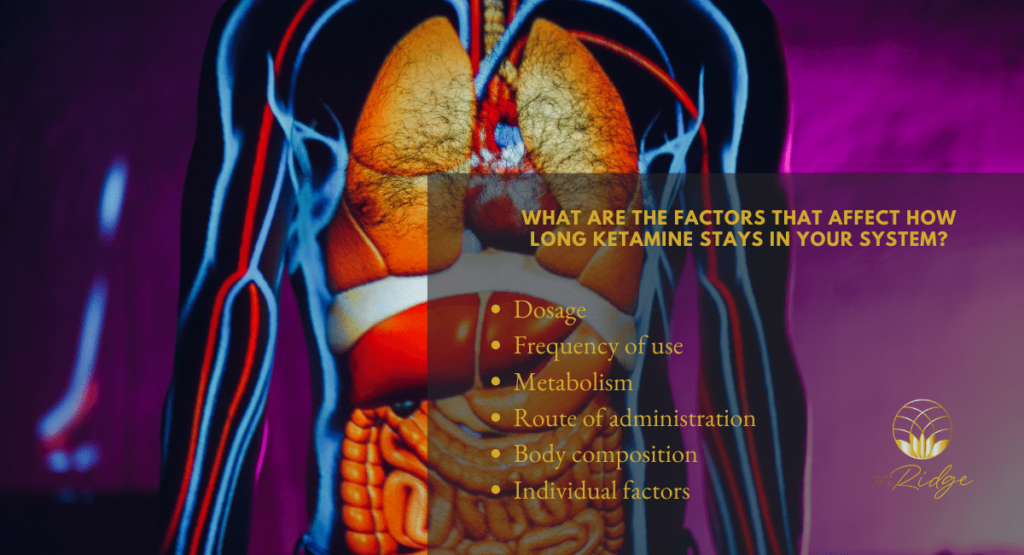
Dose. Higher doses take longer to clear. The body must process and eliminate a larger quantity of the drug and its metabolites before levels fall below detection thresholds.
Frequency of use. Ketamine accumulates in the body with repeated use. Someone who uses ketamine regularly will have a longer detection window than someone who used it once, because the drug builds up in tissue before the body can eliminate it.
Metabolism. Ketamine is primarily metabolized by the liver into a compound called norketamine. People with faster metabolisms — typically younger individuals with healthy liver function — clear the drug more quickly. Liver impairment can significantly extend clearance time.
Route of administration. Intravenous ketamine is absorbed immediately and reaches peak blood concentration fastest, but also clears from blood relatively quickly. Oral ketamine is absorbed more slowly, which can affect the overall clearance timeline.
Body composition. Ketamine is lipophilic — it tends to accumulate in fatty tissue. People with higher body fat percentages may retain the drug longer than those with lower body fat.
Individual genetics. Variation in the CYP3A4 and CYP2B6 enzymes — which drive ketamine metabolism — means clearance rates differ meaningfully from person to person even with identical doses and body types.
How Long Do the Effects of Ketamine Last?
The psychoactive effects of ketamine are much shorter-lived than its detectability on drug tests. Effects typically last:
- IV administration: 30 minutes to 1 hour (fastest onset — seconds to minutes)
- IM injection: 45 minutes to 2 hours (onset within a few minutes)
- Intranasal: 30 minutes to 1.5 hours (onset within a few minutes)
- Oral: 1 to 3 hours (slowest onset — 20 to 30 minutes)
The drug can still be detectable in urine days after the subjective effects have fully worn off. This is an important distinction for anyone facing a drug test — feeling sober is not the same as testing clean.
What Is the Half-Life of Ketamine?
Ketamine’s plasma half-life is approximately 2.5 to 3 hours when administered intravenously or intramuscularly. This means that every 2.5 to 3 hours, the concentration of ketamine in the bloodstream decreases by half. However, the drug’s primary metabolite — norketamine — has a longer half-life and is what urine tests typically detect. It takes approximately 5 to 6 half-lives to eliminate a substance to negligible levels, so the full clearance process takes considerably longer than the half-life alone would suggest.
What Are the Signs of Ketamine Abuse?
Recreational ketamine use becomes abuse when it is compulsive, escalating, or causing harm. Signs include:
Cognitive and psychological effects: Confusion, memory loss, dissociation, hallucinations, mood instability, and in heavy users, symptoms resembling psychosis.
Physical effects: Dizziness, impaired coordination, nausea, elevated heart rate, and numbness. At high doses, ketamine can cause a complete loss of motor function.
Bladder damage (ketamine cystitis): One of the most distinctive long-term harms of ketamine abuse. Chronic heavy use causes inflammation and structural damage to the bladder, resulting in frequent and painful urination, blood in the urine, and in severe cases, bladder shrinkage requiring surgical intervention. This condition is often irreversible.
Tolerance and dependence: Regular ketamine use leads to tolerance — needing more to achieve the same effect — and psychological dependence. Though ketamine withdrawal is less physically severe than opioid or alcohol withdrawal, it is real and characterized by anxiety, depression, insomnia, cravings, and cognitive fog.
What Does Ketamine Withdrawal Feel Like?
Ketamine withdrawal is primarily psychological rather than physical, but it is still a meaningful barrier to stopping use without support. Symptoms typically include:
- Anxiety, irritability, and mood swings
- Depression and anhedonia (inability to feel pleasure)
- Intense cravings for ketamine
- Insomnia and disrupted sleep
- Cognitive difficulties — memory problems, difficulty concentrating
- Mild physical symptoms: sweating, mild tremors, appetite changes
Symptoms typically begin within 24 to 72 hours of last use and can persist for one to two weeks, though psychological symptoms like depression and cravings can linger longer. For heavy, long-term users, professional support during withdrawal is strongly recommended.
When Is Ketamine Use a Problem That Requires Treatment?
If ketamine use is daily, compulsive, interfering with work, relationships, or physical health — or if you’ve tried to stop and found you couldn’t — it has become a clinical problem. Ketamine-induced cystitis, cognitive decline, and the psychological pull of dissociative experiences are serious enough that waiting is not a neutral choice.
The Ridge Ohio in Cincinnati offers treatment for ketamine dependence and polysubstance use as part of a comprehensive addiction treatment program. The Ridge is a physician-led, Joint Commission-accredited facility providing:
- Medical Detox — supervised stabilization with 24/7 physician monitoring
- Inpatient Residential Treatment — structured programming with individualized care plans
- Dual Diagnosis Treatment — addressing co-occurring depression, anxiety, or trauma alongside substance use
- PHP and IOP — step-down programs for people returning to work or home environments
- Up to 52 Weeks of Aftercare — structured continuing care following formal treatment
Call The Ridge Ohio at 513-457-7963 for a confidential conversation. Insurance verification is available at no cost.
Ketamine Drug Test FAQ
Standard 5-panel and 10-panel drug tests do not typically screen for ketamine. Ketamine requires a specific test to detect it. However, specialized panels used in clinical, workplace, or legal settings may include ketamine. If ketamine screening is a concern, confirm with the testing facility which substances their panel includes.
Ketamine and its primary metabolite norketamine are typically detectable in urine for 3 to 6 days after a single use. Heavy or chronic use can extend this detection window as the drug accumulates in the body over time.
No supplement, hydration protocol, or detox product reliably accelerates ketamine clearance beyond what the body’s normal metabolism achieves. The liver processes ketamine at its own rate — the most effective thing you can do is give it time. Attempting to dilute urine by drinking excessive water will typically be flagged by the lab as a diluted specimen.
Yes. Hair follicle tests can detect ketamine for several months to years after use, depending on the length of the hair sample tested. Hair grows approximately half an inch per month, so a 1.5-inch sample represents roughly a 90-day history. Hair tests are not affected by the same clearance timelines as blood or urine.
Ketamine produces strong psychological dependence rather than the classic physical dependence seen with opioids or alcohol. However, chronic users do experience functional withdrawal symptoms when they stop, and tolerance develops with regular use. Ketamine-induced cystitis — bladder damage from heavy use — can be a serious physical consequence even without classic physical addiction.
A K-hole refers to a state of extreme dissociation that occurs at very high doses of ketamine — characterized by an out-of-body experience, inability to communicate, and complete detachment from reality. While the experience itself is not always immediately life-threatening, it leaves the person physically incapacitated and unable to respond to their environment, making them highly vulnerable to injury, choking on vomit, or other accidents.
Prolonged heavy use of ketamine is associated with lasting cognitive impairment — particularly in memory, attention, and executive function. Research suggests these effects may partially reverse with sustained abstinence, but recovery is not guaranteed in all cases. Bladder damage from ketamine cystitis can be permanent.
Yes. The Ridge Ohio treats ketamine dependence as part of a comprehensive drug addiction program. Treatment is individualized and addresses both the substance use and any co-occurring mental health conditions. Call 513-457-7963 to speak with the admissions team in Cincinnati, Ohio. Insurance verification is available at no cost.
Tour Our Cincinnati Rehab Facility


