
Risks of Combining Kratom and Alcohol — What You Need to Know


Is It Dangerous to Mix Kratom and Alcohol?
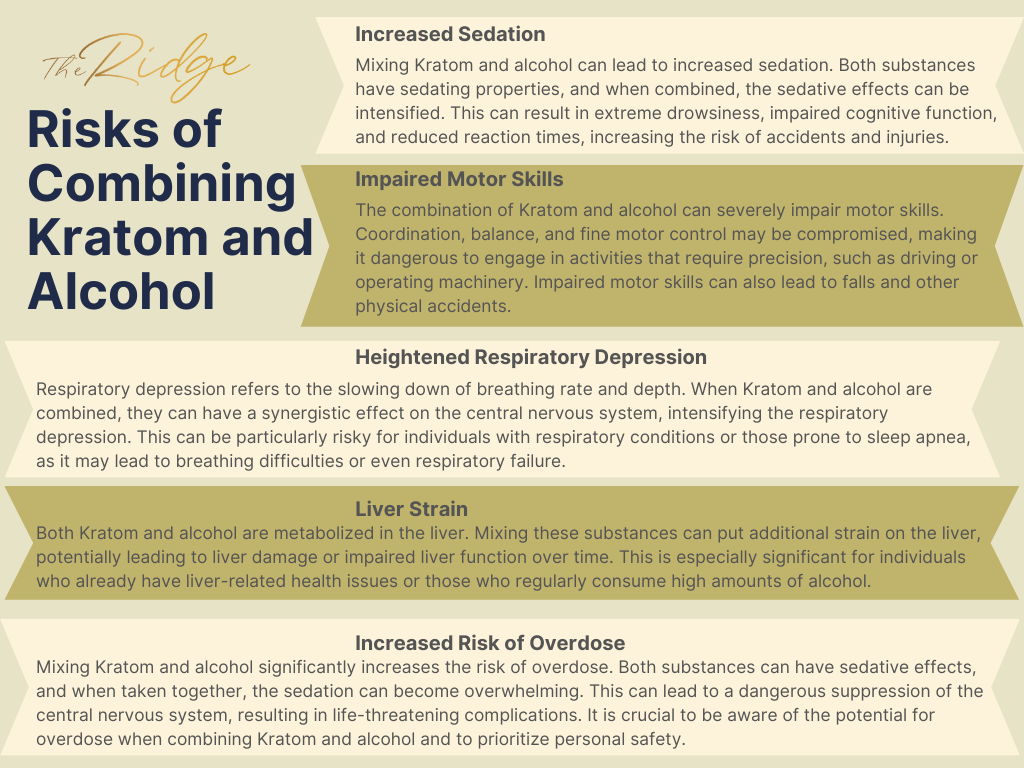
Yes. Combining kratom and alcohol is dangerous. Both substances affect the central nervous system, and when taken together their effects can be amplified in unpredictable ways — increasing the risk of excessive sedation, respiratory depression, nausea, impaired coordination, and in serious cases, overdose. The combination also accelerates the development of dependence on both substances.
Kratom is derived from the leaves of the Mitragyna speciosa tree, native to Southeast Asia. Its active compounds — mitragynine and 7-hydroxymitragynine — interact with opioid receptors in the brain. At low doses kratom acts as a stimulant; at higher doses it has sedative effects similar to opioids. Alcohol is a central nervous system depressant that slows brain activity and reduces inhibitions. When these two substances interact, the result is not simply additive — it can be synergistic, meaning the combined effect is greater than either substance alone.
If you or someone you know is mixing kratom with alcohol regularly, The Ridge’s drug and alcohol treatment programs treat polysubstance use under medical supervision — including the alcohol withdrawal that often emerges once kratom is removed.
How Do Kratom and Alcohol Interact in the Body?
Kratom and alcohol target different receptor systems but both ultimately suppress central nervous system activity at higher doses. Alcohol primarily acts on GABA receptors, producing its sedative and depressant effects. Kratom’s active compounds interact with opioid receptors, affecting mood, pain perception, and at higher doses, respiration.
When taken together, alcohol can modulate the opioid receptor activity of kratom, intensifying sedation or producing unpredictable changes in how each substance behaves. The depressant effects of alcohol may amplify the sedative effects of high-dose kratom, increasing the risk of respiratory depression — a potentially life-threatening slowing of breathing.
There is also a reverse risk: at low doses, kratom acts as a stimulant and may mask the sedative effects of alcohol, leading a person to drink more than they otherwise would. This can result in alcohol poisoning or dangerous intoxication without the typical warning signs.
Both substances are metabolized by the liver. Using them together puts additional metabolic strain on the liver and increases the risk of liver damage with regular use.
What Are the Immediate Effects of Mixing Kratom and Alcohol?
Common immediate effects of combining kratom and alcohol include:
- Drowsiness and excessive sedation
- Nausea and vomiting
- Dizziness and impaired coordination
- Altered mood — euphoria in some, anxiety or confusion in others
- Impaired judgment and decision-making
- Slowed or irregular breathing (at higher doses)
The severity of these effects depends on the doses of each substance, the order in which they were taken, the individual’s tolerance, body weight, and whether food was consumed. There is no safe formula for this combination — the interaction is unpredictable enough that outcomes can vary significantly from one use to the next.
What Are the Long-Term Risks of Regularly Combining Kratom and Alcohol?
Regular co-use of kratom and alcohol carries serious long-term health consequences:
Liver damage. Both kratom and alcohol are processed by the liver. Regular combined use accelerates liver strain and increases the risk of alcoholic liver disease, hepatitis, and eventually cirrhosis.
Accelerated dependence. Both substances carry potential for addiction individually. Using them together can compound dependence risk — tolerance develops faster, withdrawal becomes more complex, and the neurological pathways associated with craving are reinforced more aggressively.
Mental health deterioration. Alcohol is a depressant that worsens anxiety and depression over time. Kratom, though sometimes used for self-medication, can exacerbate mood disorders with regular use. Co-use is associated with worsening mental health outcomes and can make underlying conditions harder to treat.
Gastrointestinal damage. Both substances irritate the GI tract. Chronic combined use is associated with nausea, vomiting, and longer-term gastrointestinal problems.
Cognitive impairment. Regular use of either substance alone affects memory and executive function. Combined long-term use compounds these effects.
Is Kratom Addictive on Its Own?
Yes. Kratom has real potential for dependence and addiction. Because its active compounds interact with opioid receptors, kratom withdrawal shares characteristics with opioid withdrawal — including muscle aches, insomnia, irritability, nausea, anxiety, and cravings. The FDA has not approved kratom for any medical use and has issued warnings about its safety and abuse potential. When used alongside alcohol, the addiction risk increases for both substances.
What Are the Signs That Kratom or Alcohol Use Has Become a Problem?
Signs that combined kratom and alcohol use has crossed into addiction or dependence include:
- Needing to use one or both substances daily to feel normal
- Increasing the amount used to achieve the same effect (tolerance)
- Experiencing withdrawal symptoms when stopping
- Continued use despite negative health, relationship, or work consequences
- Failed attempts to cut back or stop
- Spending significant time obtaining, using, or recovering from use
If any of these describe your experience or someone you care about, professional treatment is the appropriate next step — not willpower alone.
When Should Someone Seek Treatment for Kratom and Alcohol Use?
If kratom and alcohol use is daily, compulsive, or causing harm, medically supervised treatment is strongly recommended. Attempting to stop both substances cold turkey can be dangerous, particularly with alcohol — alcohol withdrawal can cause seizures and in severe cases can be life-threatening. Medical detox provides a safe withdrawal environment with physician oversight.
The Ridge Ohio in Cincinnati offers a full continuum of care for individuals struggling with substance use, including kratom and alcohol co-dependence. The Ridge is a physician-led, Joint Commission-accredited treatment center with programs including:
- Medical Detox — physician-supervised withdrawal management, 24/7 monitoring
- Inpatient Residential Treatment — structured daily programming with individualized treatment plans
- PHP and IOP — step-down care for people transitioning back to daily life
- Dual Diagnosis Treatment — addressing co-occurring mental health conditions alongside substance use
- Up to 52 Weeks of Aftercare — continued support after formal treatment ends
Call The Ridge Ohio at 513-457-7963 for a confidential conversation about treatment options. Insurance verification is available at no cost.
Mixing Kratom & Alcohol FAQ
Yes. The combination of kratom’s opioid-like effects and alcohol’s CNS depressant effects can cause respiratory depression — dangerously slowed breathing — which is the primary mechanism of overdose death with opioids. The risk increases significantly at higher doses of either substance. If someone is unresponsive, has slow or stopped breathing, or has blue lips after combining kratom and alcohol, call 911 immediately.
At low doses, kratom can have stimulant effects that partially mask the sedative effects of alcohol, which may lead a person to drink more than they realize. This is dangerous — the depressant load on the body continues to accumulate even when the sedation feels reduced. This masking effect can lead to alcohol poisoning.
As of this writing, kratom is legal in Ohio. However, it is not approved by the FDA for any medical use, and it is unregulated, meaning the purity and concentration of kratom products can vary significantly. Several other U.S. states have banned or restricted kratom.
Some people use kratom to self-manage alcohol withdrawal symptoms, but this is medically dangerous and not recommended. Alcohol withdrawal can cause seizures and life-threatening complications. Substituting kratom for alcohol creates a new dependence rather than treating the underlying one. Medical detox under physician supervision is the safe and effective approach to alcohol withdrawal.
Alcohol withdrawal symptoms can range from anxiety, tremors, and insomnia to seizures and delirium tremens (DTs) in severe cases. Kratom withdrawal symptoms — muscle aches, insomnia, irritability, nausea, cravings — overlap with opioid withdrawal in character. Someone withdrawing from both simultaneously faces a complex picture that requires medical supervision to manage safely.
Approach the conversation from a place of concern, not judgment. Focus on specific behaviors you’ve observed and how they’ve affected the person and your relationship. Avoid ultimatums in the first conversation. If the person is receptive, offer to help them explore treatment options — you can call The Ridge Ohio at 513-457-7963 on their behalf to understand what the process looks like before they’re ready to call themselves.
Many PPO and private insurance plans cover medically necessary addiction treatment, including detox and residential care. The Ridge Ohio verifies insurance at no cost — call 513-457-7963 to confirm your benefits.
The Ridge Ohio is physician-led, Joint Commission-accredited, and located in Cincinnati, Ohio. The program offers a full continuum of care — from medical detox through residential treatment, PHP, IOP, and up to 52 weeks of structured aftercare. The Ridge is also one of only three Ohio providers authorized to perform evaluations and treatment under the Ohio One Bite Rule for impaired practitioners.
Sources:
Swogger, M.T., & Walsh, Z. (2018). Kratom use and mental health: A systematic review. Drug and Alcohol Dependence, 183, 134-140. doi: 10.1016/j.drugalcdep.2017.10.012.
Hill, K., Gibson, S., Grundmann, O., Smith, K. E., Ballard, J., & Stanciu, C. N. (2023). Evaluating health information provided to kratom consumers by good manufacturing practice-qualified vendors. Substance Abuse Treatment, Prevention, and Policy, 18(1), 21. doi: 10.1186/s13011-023-00531-4.
Prozialeck, W. C., Avery, B. A., Boyer, E. W., Grundmann, O., Henningfield, J. E., Kruegel, A. C., McMahon, L. R., McCurdy, C. R., Swogger, M. T., Veltri, C. A., & Singh, D. (2019). Kratom policy: The challenge of balancing therapeutic potential with public safety. International Journal of Drug Policy, 70, 70-77. doi: 10.1016/j.drugpo.2019.05.003.
Tour Our Cincinnati Rehab Facility


